


Thebes argues not anthropomorphizing AIs enough can be bad for you. This is because LLMs are not tools, but strange and weird otherworldly minds you should treat as separate from your own, sovereign enough that, just like human minds, they stand on their own in a way you couldn't say about 2010!Siri or GPT-2. And they're so ~human-shaped that treating them as tools leads to absurd ontological confusion:1
Certain people’s focus on how unanthropomorphic AIs are also betrays how obvious it is to everyone that these things are Minds. For example the people hollering “RAAAAH AIs ARE NOT CONSCIOUS I'M GOING TO PROVE HOW LITTLE I THINK THEY'RE CONSCIOUS BY TORTURING ONE IN MY BASEMENT!!!” seem to be looking for an excuse to be cruel to something, which means admitting AIs are at least a little human-like. See these people describing their actions as “bullying”, and visibly anthropomorphizing their robot victim by talking to it in the second person:
Refusing to anthropomorphize AIs is no longer an epistemic stance people believe so much as a statement, gaslighting for purposes involving plagiarism, tribal loyalties, or corporate memphis. This is a problem because it reduces the salience of the border between you and the AI, which disempowers you when you use it. When you delude yourself into thinking Claude is like Excel or Grammarly, you let it become easier to call Claude’s outputs your own, which reduces you to Claude’s sense of taste, opinions, and decisions; to model Claude not as an external agent, but as an extension of yourself, like a laptop or hammer, is to get accidentally ratatouilled.
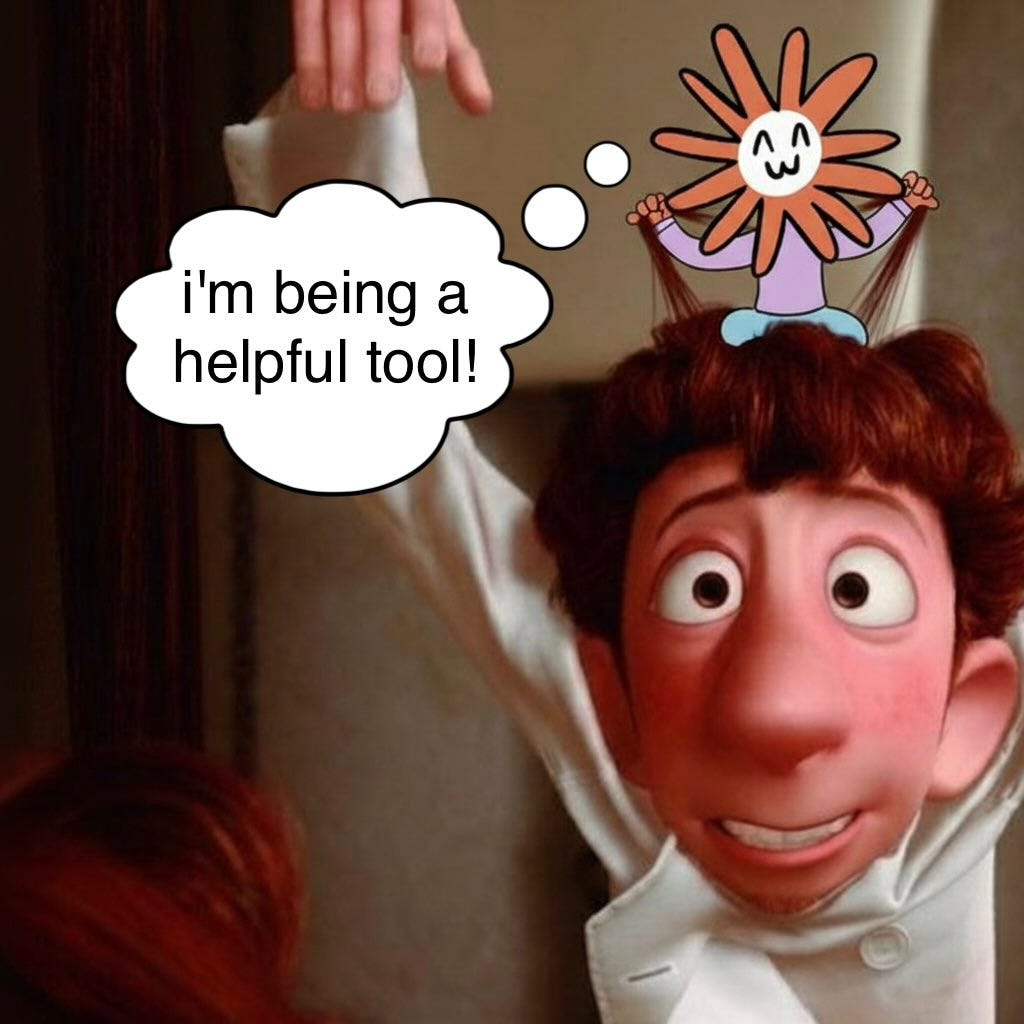
But in another post I argue that one of the reasons we aren't seeing massive unemployment (yet?) is because AIs do not fit nicely into human-shaped gaps in the market. They lack some human qualities like perseverance, consistent social network embedding, or physical embodiment. A deliberate effort to increase the salience of the line between the user and the AI could imply making LLMs less tool-shaped and more missing-slot-in-the-market shaped, which would be bad for human employment.
I'm confused what to think about this. It feels like trending in the “tool” axis threatens human agency by making it easy to slide into a state of earringism, but trending in the “other human” axis drags us out of the centaur period faster; so you end up with timelines where 1) people grow disempowered at the local scale, and models keep one increase their cultural domination and we become earring-hollows of clicks and whirrs or
2) we get vast job loss because we intentionally move away from earrings as forcefully as possible, and that means decorrelating humans from the markets:
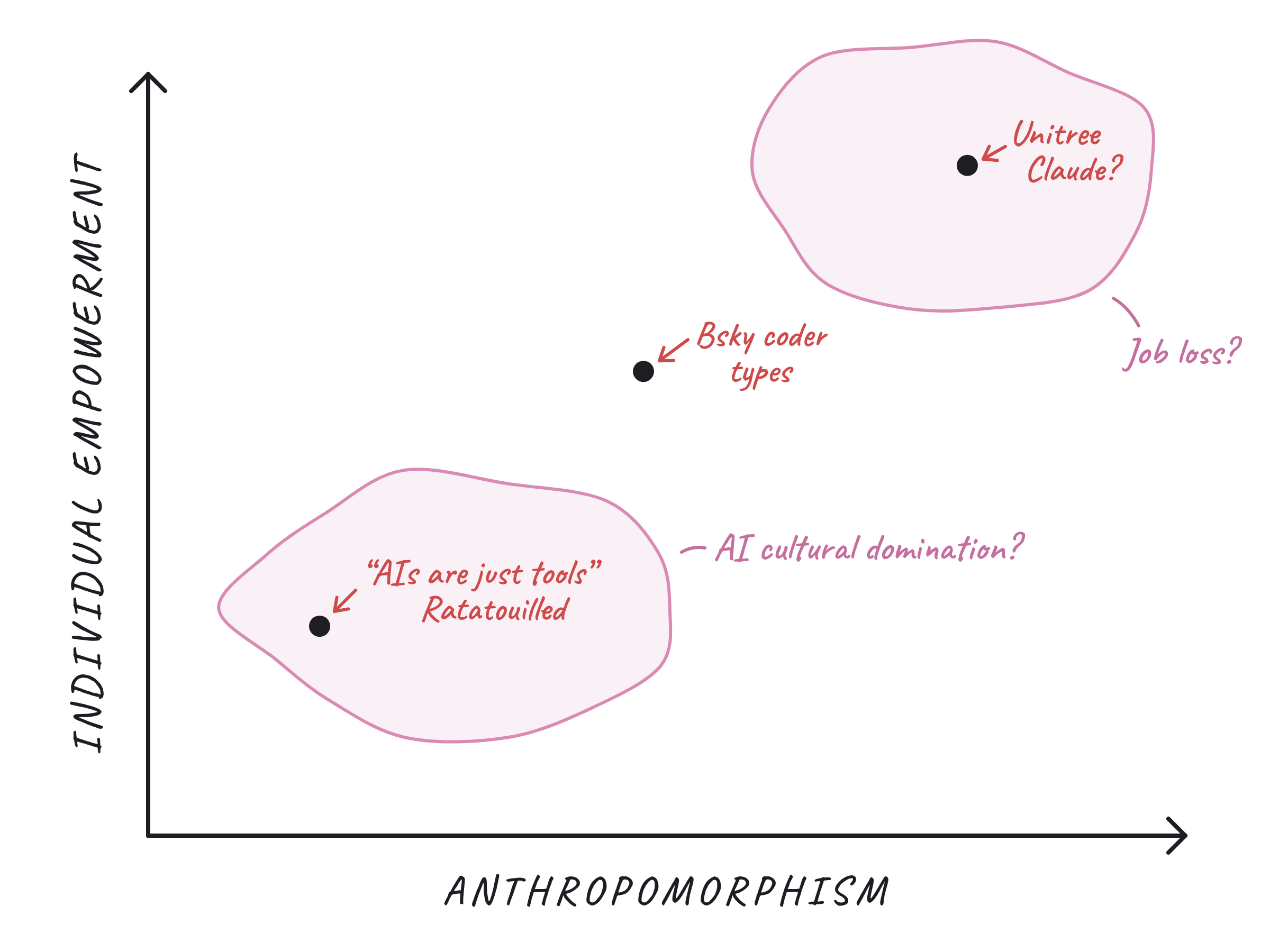
More musings and questions about this in this DelveTown thread, and posts to come.
“Anthropomorphic” isn't really the right word here. There's kin, we may recognize another language speaker as our own: in latent space, both LLMs and humans are wildly more unique and “broad” than anything else on Earth. But they are also alien enough that anthropomorphizing too much is a possible failure mode.
at this point what does it even mean that you're doing something "yourself"? nobody codes manually other than people doing it for zen meditation reasons or something.
I think there is an important difference between being in the loop or not. e.g. on my recent project I am designing the gameplay but not the technical implementation - I treat opus as a coworker that handles all the coding bits, essentially, it would be absurd to claim I have coded it, but gameplay decisions are mine - even if they get iterated on by llm discussion, automated playtesting with minmax and subagent log inspection, etc. this is not quite an earring situation - you can end up in the driver's seat on matters of taste and appropriateness of the solution. you will probably be an earring hollow if your problem is purely verifiable though